Institutional Execution Overview
Discover why standard SMC order blocks fail on Gold. Master the Liquidity Inducement Theorem (LIT) on 1-minute and 5-minute charts with real trade execution examples.
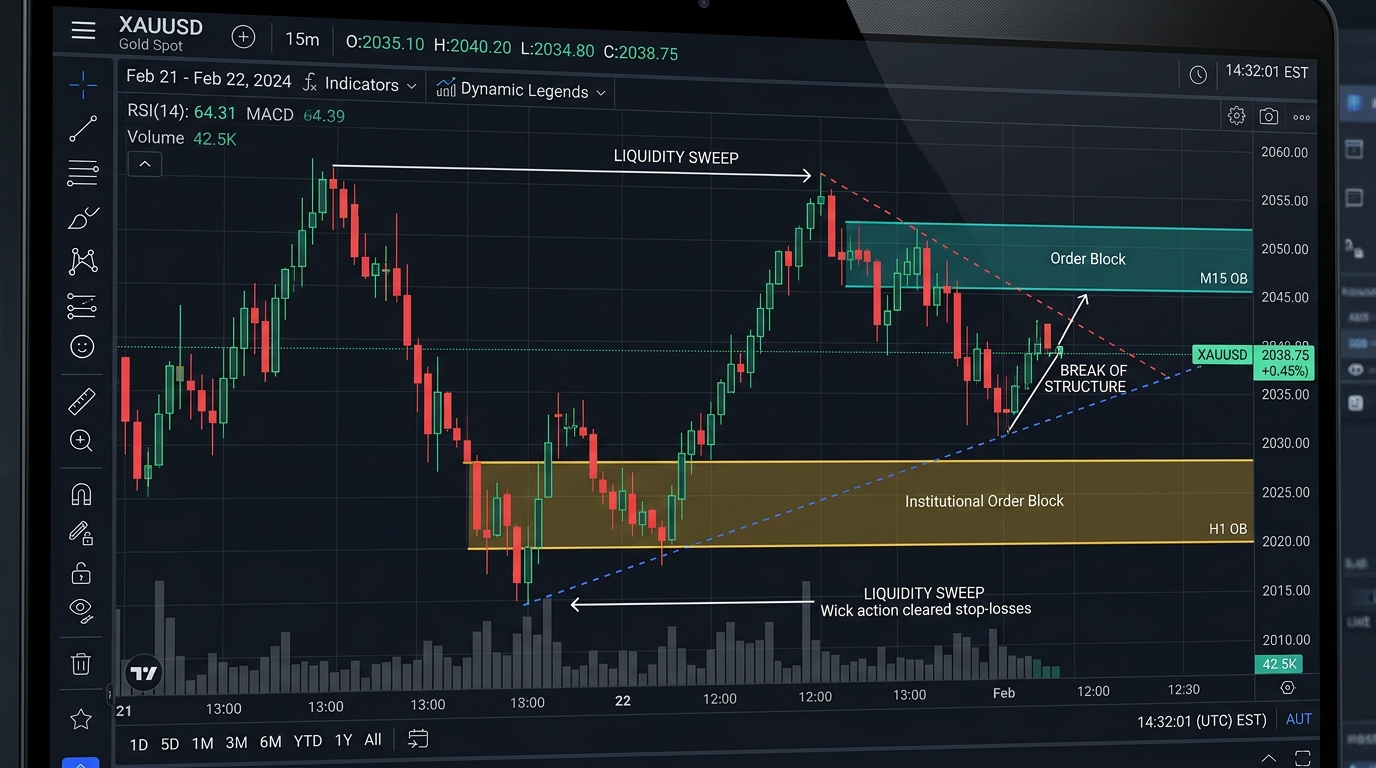
Key Takeaways
- Standard SMC is predictable: Millions of retail traders place stop-losses at the exact same decisional order blocks, making them prime targets for institutional sweeps.
- Inducement (IDM) defined: The first internal pullback after a structural break is designed to lure early market participants into becoming exit liquidity.
- The Asymmetric Setup: True institutional mitigation occurs at the Extreme Unmitigated POI, not the first visible Fair Value Gap (FVG).
- High-Beta Asset Behavior: Gold ($XAUUSD) requires tight structural confirmation (20–30 pip invalidations) paired with massive target payoffs (1:5+ R:R).
Introduction: The Retail SMC Paradox on Gold
If you have traded Gold ($XAUUSD) on lower timeframes such as the 1-minute (M1) or 5-minute (M5) chart using standard Smart Money Concepts (SMC), you have likely lived through this maddening scenario:
- Price prints a textbook Break of Structure (BOS) to the upside.
- You mark the newly created Order Block and wait patiently.
- Price pulls back into your zone, taps your limit order, hesitates for 30 seconds, and then violently slices straight through your stop loss.
- Within three candles of stopping you out, price explodes in the exact direction you predicted.
Your directional bias was spot-on, yet your account took a loss. What happened?
You did not misread the trend. You traded the Inducement (IDM).
In modern electronic markets—particularly in ultra-liquid, high-beta instruments like Spot Gold—market makers and high-frequency algorithms do not view clean order blocks as areas of support or resistance. They view them as capital repositories.
Welcome to the Liquidity Inducement Theorem (LIT).
The Architecture of Inducement: Decisional vs. Extreme
To understand LIT, you must view price delivery not through indicators or geometric chart patterns, but through the mechanics of auction theory and counterparty inventory.
                        [ External High Swept ]
                                  ▲
                                 / \
   Structural BOS               /   \
   ----------------▲-----------/     \  ◄── [ 1. Aggressive Impulse ]
                  /                   \
                 /                     ▼
                /                   [ Inducement (IDM) Formed ]
               /                       ▲  (Retail Buys the Decisional Block)
              /                       / \
             /                       /   ▼
            /                       /   [ Retail Stops Hunted ]
           /                       /           ▼
          /                       /     [ Extreme POI / Unmitigated Wick ]
         /                       /                     ▲
        /                       /                      └── Institutional Reversal Entry
   [ Low Origin ]──────────────
Under classical SMC teaching, traders are instructed to enter at the Decisional Order Block—the initial origin of the minor break. LIT categorizes this area as deliberate retail bait.
Case Study: Live M1 Execution on Gold ($XAUUSD)
Let’s review an institutional short model executed during the overlap between the London mid-session and the New York pre-market.
1. Contextual Mapping (M5 Timeframe)
- Macro Bias: Daily distributing from a major resistance zone.
- The External Pool: Asian Session High sitting clean at $2,718.50.
- The Sweep: At 07:30 GMT (London Open Killzone), Gold surges with institutional volume, wicking above the Asia High to $2,721.20, capturing all breakout buy-stops.
2. The Internal Trap (M1 Timeframe)
- Following the sweep, price rapidly crashes down to $2,713.00, confirming a Market Structure Shift (MSS).
- On the rebound, an obvious 1-minute order block forms at $2,716.00 with an attractive Fair Value Gap.
- Retail SMC traders immediately place limit short orders at $2,716.00 with stop-losses clustered tightly at $2,718.00 (20 pips).
- Under LIT rules, $2,716.00 is designated as the Inducement (IDM). We do not sell here.
3. Algorithmic Absorption & Extreme POI
- Gold rallies through $2,716.00, annihilating retail stops, and spikes directly into the Extreme Unmitigated Wick at $2,719.80.
- The 1-minute chart prints an immediate bearish displacement candle with an aggressive closing wick.
• Instrument: XAU/USD (Spot Gold)
• Execution Model: M1 Limit Retest of Absorption FVG
• Entry Price: $2,719.20
• Invalidation (Stop Loss): $2,721.80 (26 pips — above sweep peak)
• Take Profit 1 (TP1): $2,708.00 (+112 pips — Asian Session Midpoint)
• Take Profit 2 (TP2): $2,698.00 (+212 pips — Major Daily Sell-Side Liquidity Pool)
• Realized Risk-to-Reward: 1 : 8.1
                  [ Sweep of Asia High: $2,721.20 ]
                                ▲
                               / \
   Retail Decisional OB       /   \   [ Sharp Downward Displacement ]
   [ IDM: $2,716.00 ] ───►   /     ▼
                            /       \
                           /         ▲  Retail Stops Purged
                          /           \ tap into Extreme POI ($2,719.80)
                         /             ▼
    [ Origin $2,713.00 ]/               \──────► Expansion to $2,698.00
The 4-Step LIT Execution Checklist for Scalpers
Before pulling the trigger on any lower-timeframe Gold setup, run through this non-negotiable verification sequence:
- Identify the External Liquidity Sweep (ERL): Has Gold purveyed a key structural session high or low (Asia High/Low, Previous Day High/Low)? If no sweep has occurred, you are trading noise.
- Locate the Inducement (IDM): Where is the first internal pullback that retail traders are attempting to buy or sell? Highlight this level as dangerous.
- Isolate the Extreme POI: Find the origin of the impulse or the unmitigated wick shadow that created the initial displacement.
- Wait for Invalidation of the Herd: Allow price to liquidate the IDM. Enter on the subsequent rejection candle or internal FVG retest on the M1 chart.
Frequently Asked Questions (FAQ)
What makes LIT different from standard Smart Money Concepts (SMC)?
Standard SMC treats almost every Fair Value Gap and Order Block as a valid zone. LIT acknowledges that algorithms intentionally print visible order blocks to manufacture counterparty volume (inducement). LIT waits for the failure of these decisional zones before entering at the institutional origin.
What is the ideal stop-loss size for Gold on M1/M5 charts?
With the LIT model, entries occur at extreme points of liquidity absorption. A valid stop loss should rarely exceed 25 to 35 pips ($2.50 to $3.50 on Gold price). If your setup requires a 60-pip stop loss on the 1-minute chart, your entry timing is premature.
Can LIT be traded on higher timeframes like H1 or H4?
Yes. Liquidity dynamics are strictly fractal. However, lower timeframes (M1 and M5) display the actual microstructural absorption phase in real-time, allowing for asymmetric risk-reward ratios ranging from 1:5 to 1:12.
⚡ Automated Algorithmic Power: ATGOLDEN Expert Advisor
Every institutional sweep parameter and risk model explained in this guide is natively coded into the ATGOLDEN MT5 Expert Advisor for automated precision execution on Gold (XAUUSD).
Explore & Acquire ATGOLDEN EA ➔
3 responses to “The Liquidity Inducement Theorem (LIT) Guide for Gold Scalpers: How Institutional Algorithms Hunt Retail SMC on M1 & M5”
My specific market requires a deeper look at how volatility shifts affect the setup. This often changes the entry logic significantly.
Hello my name is Hossein Taheri I sand 49$my email
hosseintaheri13@yahoo.com
I’m waiting
Hello thank you we sent all documents and EA file